
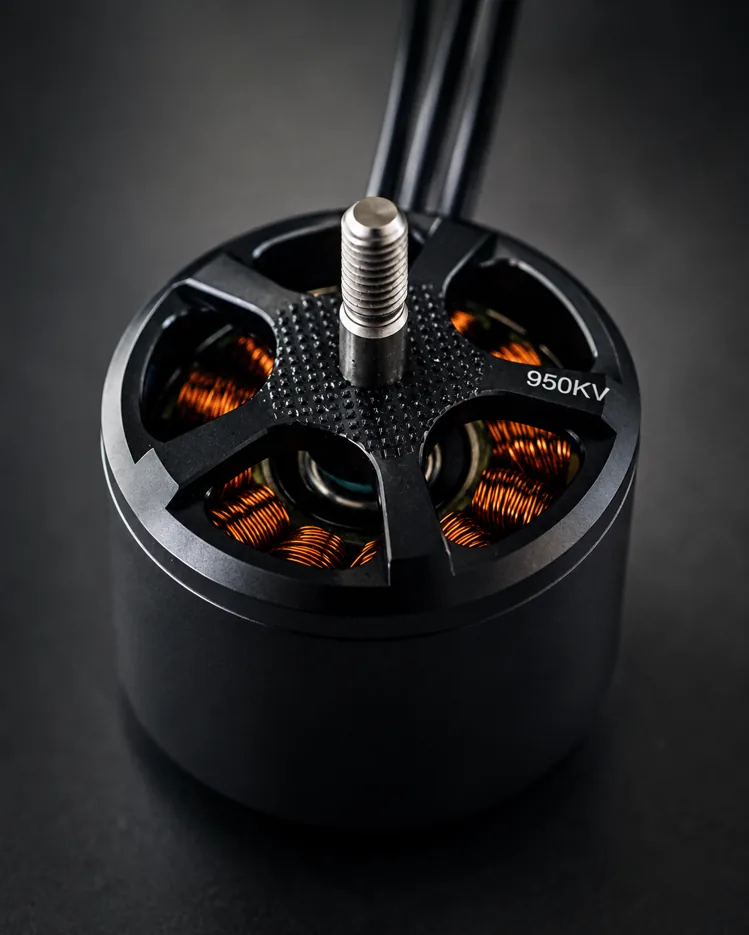
950KV
3220 · 6SHigh response
Developed for interceptor and FPV-class applications.
Midguard 3220
A pre-production 6S outrunner platform for European UAV manufacturers, with 700 KV and 950 KV development variants.
Platform facts reflect the current development configuration. Configuration-specific performance data is shared with qualified OEM partners.
Development variants
Both variants share the 3220 outrunner architecture and 6S battery configuration. The KV rating positions each variant for a different UAV duty profile.
950KV
3220 · 6SDeveloped for interceptor and FPV-class applications.
700KV
3220 · 6SDeveloped for endurance-focused applications where lower KV and efficient operation are priorities.
Final performance depends on the complete propulsion setup, including propeller, ESC, voltage, cooling and duty cycle. Configuration-specific test data is available to qualified OEM partners.
Application positioning
Motor performance cannot be separated from battery voltage, propeller, ESC, cooling and duty cycle. Midguard therefore works with OEMs at system level and provides configuration-specific data and recommendations.
Positioned for interceptor and FPV-class platforms where rapid throttle response and acceleration dominate the duty profile.
Positioned for endurance-focused platforms where lower KV and efficient operation across long, steady segments are the priority.
Development status
Published pre-production test summary
The figures below are taken from the public product overview of September 2026. They describe one pre-production evaluation setup. Peak values should not be interpreted as one simultaneous operating point or a continuous rating.
Pre-production unit as measured in the published overview.
Electrical input power, not shaft output power.
Highest thrust observed in testing.
Current 6S setup with 700 KV and 950 KV pre-production variants.
Sourcing approach
Final assembly in Europe is not enough if critical motor components still depend on one supply region. The 3220 was designed so that magnet and component configuration can follow the OEM program’s continuity requirements.
Developed from scratch to support European-sourced rare-earth magnet configurations and reduce dependence on a single supply region.
Component strategy is defined per OEM program against a specific product configuration, so sourcing statements can be traced to the bill of materials.
Repeatable pilot production is being prepared in Finland alongside the current OEM evaluation phase.
OEM engagement
Requirements cover operating profile, voltage, propeller envelope, environment, compliance needs and volume.
A 3220 variant and component configuration are proposed against the defined requirements.
Samples are evaluated on the bench and in the OEM’s own setup, with a qualification plan agreed together.
Repeatable pilot batches are produced in Finland once the configuration is frozen.
Volume ramp is planned against demonstrated pilot output and the program’s own timeline.
Next step
Share your platform, operating profile and expected volumes. We respond with the relevant 3220 variant, configuration recommendations and the current sample situation.